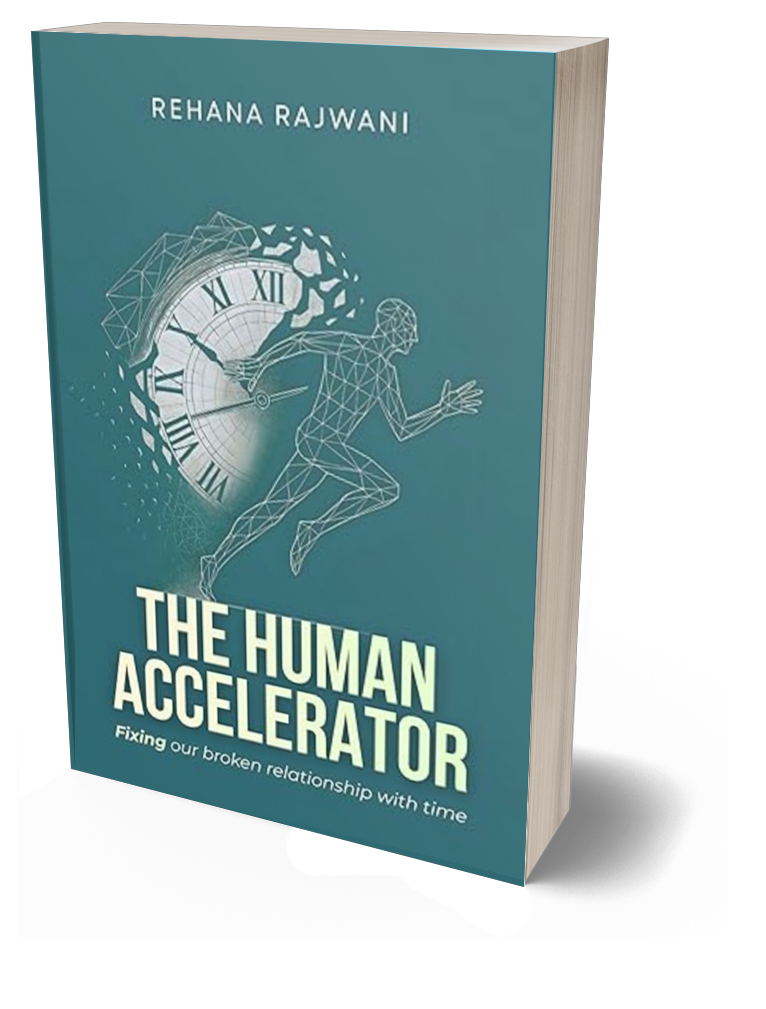
Fixing Our Broken Relationship With Time

The Human Accelerator

By Rehana Rajwani

The Human Accelerator

Why Time Feels Broken at Work

Time feels broken at work because effort is being consumed faster than it can compound.

Most organizations operate at high speed without stable momentum. Work moves in bursts, priorities change before effort compounds, and teams stay busy while progress remains fragile. The result is a constant sense of urgency paired with surprisingly little traction. 

When output slows, the typical response adds pressure in the form of more meetings, more tools, more people, and more urgency. Each addition introduces friction into the system, even when intentions are good. Over time, that friction drains energy, blurs direction, and makes time feel scarce regardless of how many hours are spent working.

This pattern creates a distorted experience of time.

You experience work in patterns

Understand Productivity Through Physics

Some weeks, effort carries forward with ease, while other weeks, the same effort meets resistance, delay, or fatigue. Projects that looked solid lose traction. Teams that appear capable struggle to move together. Progress holds briefly, then slips. Physics gives you a way to understand why this happens.

In physics, movement follows observable rules:

Momentum determines whether effort sustains.

Force explains why certain actions change direction while others dissipate.

Friction shows where time and energy are being consumed.

Stability determines whether progress holds under pressure.

The Human Accelerator applies these principles directly to your day-to-day work. It helps you understand why pressure sometimes produces movement and often creates drag. It explains why effort feels heavy in one environment and lighter in another. It gives you a way to see what is shaping outcomes beneath surface activity.

This book gives you language for what you already experience and a way to reason about it. You can see where progress is leaking, where intervention matters, and where pushing harder only increases load.

When you understand how work moves, time stops feeling erratic. You regain control over pace, direction, and follow-through.

"You were phenomenal Rehana! What an energetic and fresh perspective you brought to the conference with the logic of organizational physics. I wish I could go back and press replay. 😁"

Talk Testimonial
Attendee

Why Read The Book

Find Stability in the Middle of Motion

After reading The Human Accelerator, you’ll notice several practical shifts in how you work and lead:

Decisions feel calmer under pressure

You can tell when to act, when to wait, and when pushing will make things worse.

Urgency loses its grip on your day

You stop reacting to everything at once and start moving work forward with intention.

You know what to look for when progress slows

Instead of blaming effort or people, you can spot where friction or instability is blocking movement.

Your interventions become more precise

Fewer meetings, fewer resets, fewer last-minute fixes that create more work later.

These shifts change how work feels on a daily basis, with less strain, fewer false starts, and more progress that actually holds.

Who this book is for

This Book is Written for People Responsible for Work Moving Forward

You see teams working harder while output declines. You have watched added support slow progress instead of accelerating it. You operate in environments where urgency dominates, yet stability remains elusive.

The Human Accelerator is especially relevant if you:

Lead through growth, change, or complexity

You are responsible for sustaining momentum while conditions continue to shift.

Value clear thinking and systems insight

You prefer understanding how work behaves over relying on surface-level tactics.

Manage team performance and delivery

You feel the tension between pressure, pace, and long-term effectiveness.

If you are looking for slogans, motivation, or abstract advice, this book will feel unnecessary, but if you want clearer thinking about how work actually moves and how to influence it with less strain, it will feel familiar very quickly.

“Sustainable performance is about learning the choreography of energy - when to push, when to pause, and when to plug back in.”
- Rehana Rajwani

About Rehana

Meet the Author

Hi, I am Rehana Rajwani.

I work in leadership and systems thinking, with a long-standing interest in how people operate under pressure.

Through my work with individuals, teams, and organizations, I began to notice a consistent pattern. Productivity challenges rarely came down to effort, motivation, or discipline. They showed up when momentum broke down, energy dispersed, and change was applied without a clear understanding of how systems behave over time.

I’ve always enjoyed explaining complex ideas in ways that feel practical and usable. Over time, I started using principles from physics to make sense of everyday work. Concepts like momentum, friction, force, and elasticity offered a clear language for experiences leaders and professionals already recognized but struggled to describe.

The Human Accelerator grew out of that work. The book is designed to help people reduce unnecessary struggle, ask more precise questions, and create progress that holds. My focus is on clarity, steadier movement, and building momentum without relying on constant urgency or pressure.

The Human Accelerator

Start Working with Time Instead of Pushing Against It!

The Human Accelerator gives you a clearer way to understand why work speeds up, slows down, or stalls, and how to influence it without adding pressure. If you want steadier momentum, better judgment under load, and progress that holds, this book offers a practical place to begin.

Copyright © 2026 The Human Accelerator